
Industrial flow control relies heavily on two primary actuation methods: electromagnetic and fluid power. Choosing between a solenoid valve and a pneumatic valve requires an understanding of response times, environmental constraints, and energy efficiency. While both components regulate fluid or gas flow, their internal mechanisms and power sources differ significantly, impacting long-term operational costs and system reliability in automated production lines.
Core Differences Between Solenoid and Pneumatic Actuation
International Society of Automation (ISA), solenoid valves are preferred for high-speed, low-flow applications, while pneumatic systems excel in heavy-duty environments requiring high torque and safety in explosive atmospheres.
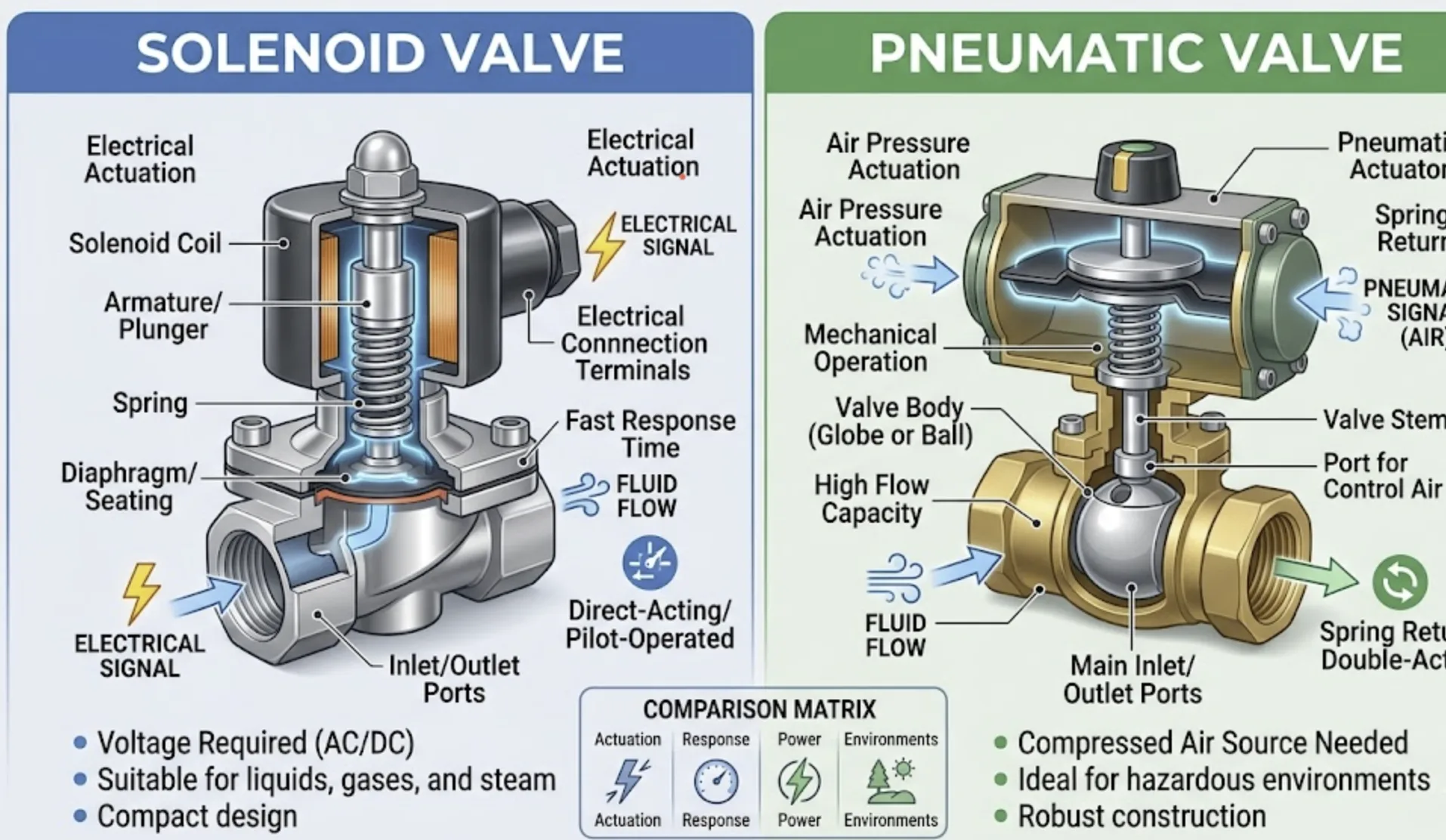
Technical Specification Comparison
The following table outlines the fundamental performance metrics for standard industrial models, facilitating an objective comparison of their functional capacities.
| 특징 | 솔레노이드 밸브 | 공압 밸브 |
| 전원 | Electricity (AC/DC) | Compressed Air (6-10 bar) |
| 응답 시간 | 5ms to 50ms | 30ms to 150ms |
| 듀티 사이클 | Limited by Heat Dissipation | Continuous Operation |
| Fail-Safe Mode | Spring Return (Electric) | Mechanical Spring or Air Tank |
| Torque/Force | 보통의 | 매우 높음 |
Advantages of Electric Solenoid Control Systems
2/2 way solenoid valve
solenoid valve manifold
Strengths of Pneumatic Actuated Valve Systems
Pneumatic valves are the industry standard for hazardous environments where electrical sparks pose a combustion risk. These valves utilize air pressure to provide high mechanical force, making them suitable for large-diameter pipelines and heavy viscous fluids. 표준 pneumatic directional control valve
4V series pneumatic valve
Operational Constraints and Limitations
U.S. Department of Energy (DOE)
pneumatic fittings and connectors
Performance Analysis: Speed vs. Force
In terms of mechanical performance, the choice depends on whether the application prioritizes speed or raw power. Solenoid valves are the fastest, often reaching full transition in under 10 milliseconds. This makes them ideal for sorting machines and inkjet printing. However, if the task involves moving a heavy gate or ball valve, a pneumatic actuator is necessary to overcome the static friction and fluid resistance found in industrial processing.
| Application Criteria | Recommended Technology | 추리 |
| Explosive Atmosphere | 영적인 | No electrical spark risk (ATEX compliant) |
| Compact Lab Equipment | Solenoid | Small footprint, no compressor needed |
| High Frequency Cycling | Solenoid | Faster response and lower latency |
| Large Scale Infrastructure | 영적인 | Higher force-to-weight ratio |
Environmental Impact and Safety Standards
IEC 61508 pneumatic mechanical valve
에 따르면 2025 Industrial Automation Report 공압 공기 실린더
Maintenance and Long-Term Reliability
pneumatic mufflers and silencers
Conclusion: Selecting the Right Valve Technology
The decision between solenoid and pneumatic valves is governed by the specific requirements of the automation system. Solenoid valves offer the best solution for rapid, precise, and electrically integrated flow control in clean environments. Pneumatic valves remain the superior choice for high-force applications, hazardous locations, and systems where compressed air infrastructure is already established. Balancing the initial investment against operational efficiency and maintenance needs is the key to optimizing industrial fluid power systems.
FAQ
Can a solenoid valve be used in a pneumatic system?
Yes, a solenoid-controlled pneumatic valve uses an electric signal to manage the flow of compressed air, which then actuates a larger valve spool. This hybrid approach combines the fast signal processing of electronics with the high mechanical force of pneumatic power for complex industrial automation.
How do I troubleshoot a solenoid valve that won’t open?
First, verify the input voltage matches the coil specifications using a multimeter. If the electrical supply is stable, check for a burnt-out coil or a clogged pilot orifice. Mechanical obstruction within the valve body caused by fluid debris is another common cause of failure in electromagnetic actuators.
What are the safety benefits of pneumatic valves in oil and gas?
Pneumatic valves are inherently explosion-proof because they operate using air pressure rather than electricity. In environments with flammable vapors, removing electrical components eliminates the risk of ignition. Furthermore, pneumatic actuators can provide high-speed emergency shutdown (ESD) capabilities using stored compressed air tanks.
Which valve type has a longer service life?
Pneumatic valves generally have a longer mechanical service life in heavy-duty applications because they lack delicate electronic components. However, solenoid valves can achieve millions of cycles in light-duty, clean environments if the electrical coil is protected from overheating and voltage spikes through proper circuit design.
How does fluid temperature affect valve selection?
High fluid temperatures can degrade the insulation of a solenoid coil, leading to premature failure. In such cases, pneumatic valves or solenoids with high-temperature FKM or PTFE seals are required. For extreme heat, pneumatic actuators are preferred as the power source is physically isolated from the heated valve body.