
In the world of industrial automation, the Directional Control Valve (DCV) is the unsung hero. Often referred to as the “brain” of a pneumatic circuit, its primary function is to regulate the flow of compressed air to various actuators. Understanding the directional control valve working principle is crucial for engineers looking to optimize system efficiency and reduce downtime.
The Anatomy of a Pneumatic Directional Valve
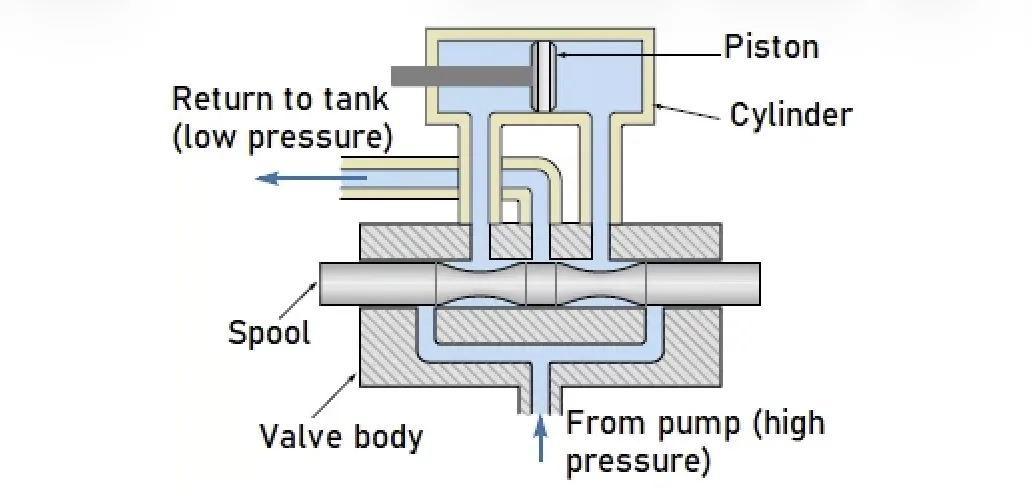
To understand how these valves work, we must first look at their internal structure. Most modern high-performance directional valves utilize a spool-and-bore design
The Valve Body: A precision-machined housing, usually made of anodized aluminum alloy for durability and corrosion resistance.
The Spool: A cylindrical component that slides back and forth inside the body.
Lands and Grooves: The spool features raised sections called lands (which block airflow) and recessed areas called grooves (which allow air to pass between ports).
Sealing Elements: High-quality NBR or Viton seals are used to prevent internal leakage, ensuring the system maintains pressure.
The Working Principle of Directional Valve
The fundamental directional valve mechanism relies on the linear displacement of the spool to switch air passages.Next, I will mainly introduce the working method of this type of valve, focusing on the working steps of the 5/2-way directional valve.
A 5/2-way valve (5 ports, 2 positions) is the industry standard for controlling double-acting pneumatic cylinders.
Rest Position: In its default state, the spool is held in place (often by a spring). Air flows from the Inlet Port (P) to Outlet Port (B), keeping the cylinder retracted.
Actuation: When the solenoid coil is energized, it creates a magnetic field that pulls the spool.
Channel Realignment: As the spool shifts, the lands uncover different ports. Now, air flows from Port P to Port A, causing the cylinder to extend, while exhaust air from the other side escapes through the Exhaust Port (S).
De-energization: Once the signal stops, the spring pushes the spool back, reversing the flow and retracting the actuator.
For complex systems, individual valves are typically grouped into a valve manifold. Centralized solutions reduce wiring complexity, save space, and support fieldbus protocols such as IO-Link or EtherCAT, significantly improving diagnostic capabilities. This is what’s known as a valve island, where multiple valves work together.
Three Types of Actuation Methods
Depending on the application environment, different actuation methods are used to shift the spool
Solenoid Actuated (Electric): Uses electrical signals from a PLC. This is the foundation of Industry 4.0 and smart factory automation.
Air-Piloted (Pneumatic): Uses a small air signal to move the main spool. These are ideal for explosion-proof environments or high-temperature zones.
Manual & Mechanical: Lever, button, or roller-operated valves are essential for manual overrides, safety interlocks, and emergency stops.
Why Selection Matters: Ports, Positions, and Flow Rates
Choosing the right pneumatic component requires looking beyond just the price. Engineers must consider
Flow Capacity (Cv Value): Selecting the correct thread size (M5 to 1/2″) ensures your pneumatic cylinder moves at the required speed without “choking” the system.
Center Functions: In 3-position valves, the center state (Closed Center or Exhaust Center) determines if a load stays locked in place or drops during a power failure.
FAQ
Q1: What causes a directional valve to “stick” or fail?
A: The most common cause is poor air quality. Moisture, dust, or degraded oil can cause the spool to stick. Using a high-quality FRL unit (Filter, Regulator, Lubricator) is the best preventative measure.
Q2: Can I use a 3/2-way valve to control a double-acting cylinder?
A: No. A 3/2-way valve is designed for single-acting cylinders (spring return). For double-acting motion, you require a 5/2-way or 5/3-way directional valve.
Q3: How do I identify a leak in my solenoid valve?
A: Listen for a constant hissing sound from the exhaust ports. This usually indicates worn internal seals or a spool that hasn’t fully shifted due to low pilot pressure.
About SENYA: Your Global Partner in Pneumatic Excellence
As a professional manufacturer of pneumatic components, we specialize in providing high-precision solutions for modern manufacturing. Our factory integrates advanced CNC machining with rigorous testing protocols to ensure every component exceeds industry standards.
Our Core Product Range
Solenoid Valves: Ultra-fast response times and high cycle life for demanding automation.
Directional & Pilot Valves: Versatile control options including air-piloted and manual versions.
Pneumatic Cylinders: Robust linear actuators available in standard, compact, and customized sizes.
Pneumatic Push-in Fittings: Premium one-touch fittings for secure, leak-free connections with PU and Nylon tubing.
Whether you are an OEM machine builder or a maintenance professional, we provide the quality pneumatic parts you need to keep your production moving. Contact our technical team today for customized quotes and expert selection support!