
Pneumatic Components Lubrication
Proper lubrication of pneumatic cylinders reduces seal wear, lowers friction, improves stroke consistency, and helps prevent premature failure. The key principle is simple: only lubricate pneumatic cylinders when the cylinder design, seal material, and manufacturer guidance require lubrication. Many modern cylinders are pre-lubricated for life, while older or heavy-duty cylinders may need controlled air-line lubrication or periodic grease service.
Incorrect lubrication can damage seals, attract contaminants, and slow actuator response. According to the U.S. Department of Energy compressed air guidance, poor air treatment and leakage increase maintenance cost and energy waste. Clean, dry, correctly lubricated air supports reliable motion and lower downtime. For replacement components, common options include pneumatic cylinder accessories, air preparation unit, FRL unit, pneumatic lubricator, air cylinder seals, and industrial pneumatic fittings.
Why Pneumatic Cylinder Lubrication Matters in Air Automation Systems
A pneumatic cylinder converts compressed air into linear motion. Internal piston seals, rod seals, bearings, and guide surfaces slide during each cycle. Without correct lubrication, friction rises and wear particles increase.
Lubrication provides four measurable benefits:
-
Reduces seal abrasion during repeated cycling
-
Lowers stick-slip motion at low speed
-
Protects rod and bore surfaces from corrosion
-
Extends maintenance intervals in high-cycle service
The OSHA safety resources also emphasize preventive maintenance because failing pneumatic equipment can create pinch and motion hazards. Stable cylinder performance supports safer machine operation.
| Lubrication Effect | Operational Result | Maintenance Benefit |
|---|---|---|
|
Lower friction |
Smoother motion |
Less seal wear |
|
Surface film |
Better protection |
Longer component life |
|
Reduced drag |
Faster response |
Lower air consumption |
|
Noise reduction |
Quieter stroke |
Better diagnostics |
Do All Pneumatic Cylinders Need Lubrication?
Not every pneumatic cylinder requires added lubricant. Many ISO cylinders and compact cylinders leave the factory with permanent internal grease. Manufacturers often state that once external oil mist is introduced, continuous lubrication should continue because seals adapt to the oil film.
Check three factors before adding lubricant:
-
Cylinder manual or technical datasheet
-
Seal material such as NBR, PU, or FKM
-
Duty cycle and environment
The National Institute of Standards and Technology (NIST) regularly highlights preventive maintenance and measurement consistency across industrial systems. Applying lubricant without specification control can reduce consistency instead of improving it.
Best Lubricants for Pneumatic Cylinders and Air Cylinders
The best lubricant for pneumatic cylinders is usually a light mineral-based pneumatic oil or manufacturer-approved synthetic oil with anti-wear additives. Heavy grease is generally unsuitable for air-line mist systems because atomization is poor.
Use this selection guide:
| Cylinder Condition | Recommended Lubricant | Notes |
|---|---|---|
|
Standard factory cylinder |
Manufacturer-approved oil |
Verify seal compatibility |
|
High-cycle automation |
Light pneumatic oil ISO VG range |
Stable mist delivery |
|
Food or clean area |
Approved specialty lubricant |
Check compliance rules |
|
Rod surface manual service |
Thin protective grease |
Use sparingly |
Avoid automotive engine oil, penetrating spray, or solvent-based oil. These fluids may swell seals or wash out factory grease.
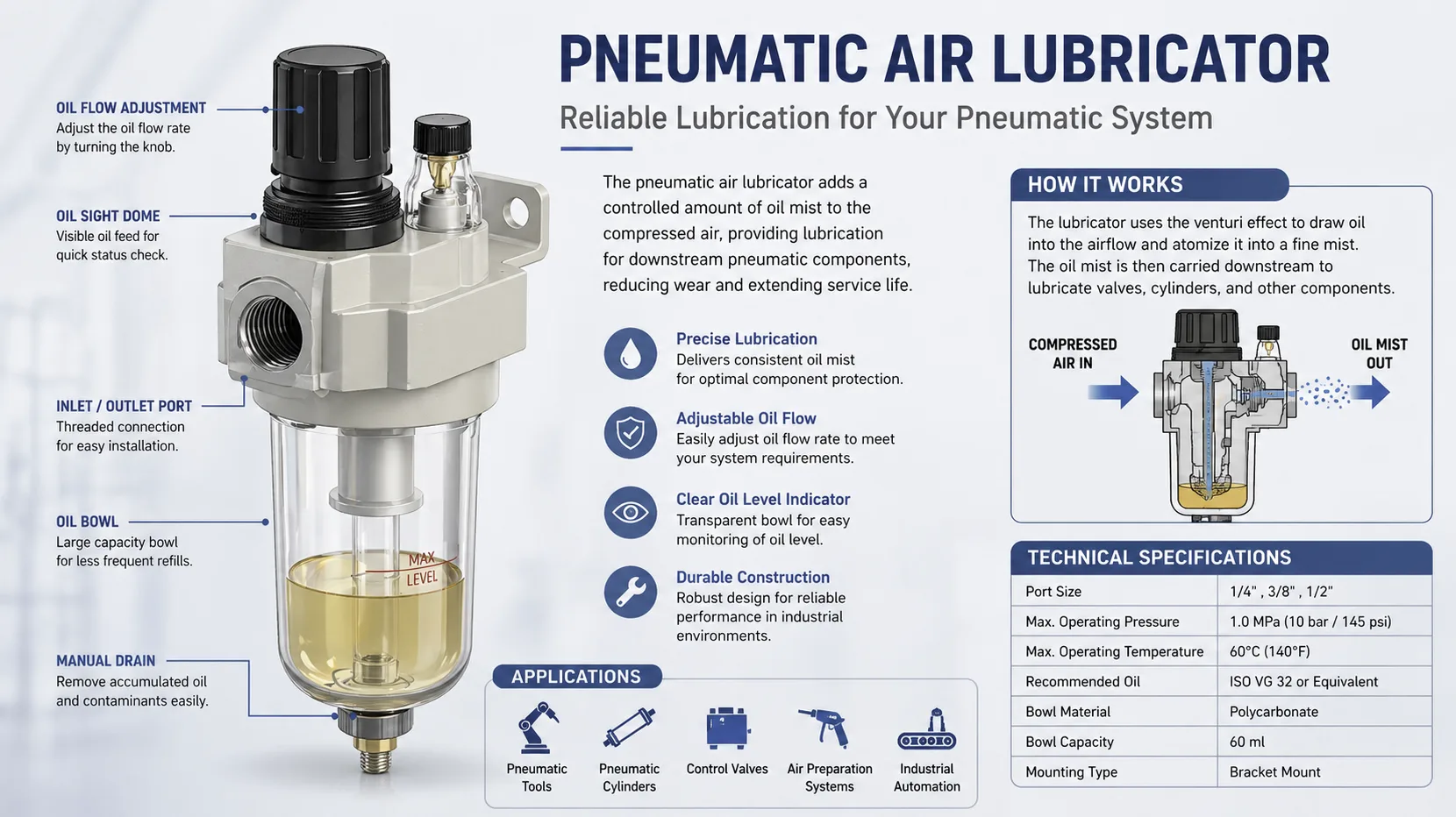
For supply systems, many plants install an air line lubricator or filter regulator lubricator assembly.
How to Lubricate Pneumatic Cylinders Correctly Step by Step
Correct lubrication starts with clean air. Water, rust, and dust shorten seal life faster than lack of oil in many systems.
Air-Line Lubrication Method
-
Isolate air supply and depressurize the line.
-
Fill the lubricator bowl with approved pneumatic oil.
-
Adjust drip rate according to flow demand.
-
Restart equipment and observe downstream mist delivery.
-
Verify cylinder motion remains smooth and repeatable.
Manual Cylinder Service Method
-
Retract the rod fully.
-
Clean exposed rod with lint-free cloth.
-
Apply a thin film to rod surface if manufacturer permits.
-
Cycle slowly several times.
-
Remove excess lubricant to prevent dust buildup.
The NIOSH industrial safety resources note that lockout and stored energy control remain essential during maintenance work.
How Much Lubrication Does a Pneumatic Cylinder Need?
Over-lubrication is a common mistake. Excess oil can migrate into valves, silencers, sensors, and product zones. Under-lubrication may cause jerky motion or dry seal wear.
Use these indicators:
-
Too little lubrication: squeal, hesitation, slow return stroke
-
Too much lubrication: oil discharge, sticky dust buildup, muffler saturation
-
Correct lubrication: stable speed, quiet motion, clean exhaust trace
The ISO standards organization publishes standards widely used for pneumatic component testing and system consistency. Controlled quantity is more important than frequent random oil addition.
Common Pneumatic Cylinder Lubrication Mistakes
Many failures come from wrong practice rather than poor hardware.
| Mistake | Risk | Better Practice |
|---|---|---|
|
Using random oil |
Seal damage |
Use approved pneumatic oil |
|
No filtration |
Dirt abrasion |
Install filter unit |
|
Excess drip rate |
Valve contamination |
Fine-adjust lubricator |
|
Mixing grease and oil |
Sludge formation |
Clean before change |
|
Ignoring leaks |
Air waste |
Repair seals and fittings |
Compressed air leaks also increase cost. The DOE notes that leakage can represent a major share of avoidable compressed-air losses in plants.
How to Build a Reliable Pneumatic Lubrication System
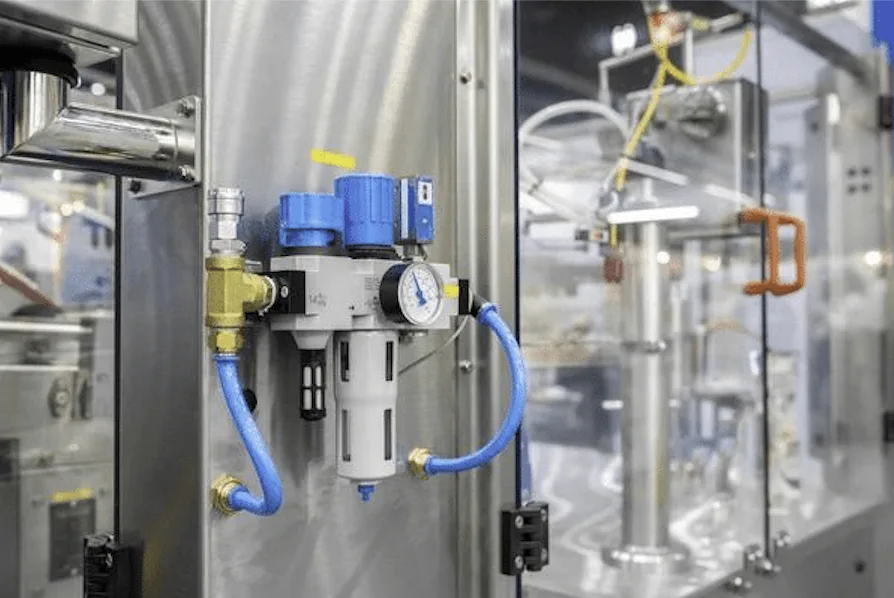
A complete air preparation train often performs better than lubrication alone. Standard sequence:
-
Filter removes particulates and condensate
-
Regulator stabilizes working pressure
-
Lubricator meters oil mist when required
-
Clean tubing delivers conditioned air
This arrangement is commonly sold as an FRL combination unit. For cylinder replacement projects, matching bore size, stroke, and port size remains equally important.
Key conclusion: clean dry air is the first priority; added oil is the second priority only when the cylinder specification requires it.
FAQ
1. Can WD-40 be used to lubricate pneumatic cylinders?
WD-40 is not a dedicated pneumatic cylinder lubricant. It may act as a cleaner or temporary penetrant, but it is not the preferred long-term lubricant for seals and internal air components. Use manufacturer-approved pneumatic oil instead.
2. How often should pneumatic cylinders be lubricated?
Lubrication interval depends on cycle rate, air quality, load, and cylinder design. Some pre-lubricated cylinders need no added oil for years. Heavy-duty systems with lubricators may require periodic bowl refill and monthly inspection.
3. What happens if a pneumatic cylinder is over-lubricated?
Too much lubricant can foul valves, contaminate sensors, clog silencers, and collect dust on rod surfaces. Excess oil may also reach products in packaging or clean processes. Controlled dosage is safer than heavy dosing.
4. Is grease better than oil for air cylinders?
Oil is usually better for air-line lubrication because oil atomizes into mist. Grease may be useful for specific rod bearings or manual service points if approved by the manufacturer. Internal random grease packing is not recommended.
5. Why does a lubricated pneumatic cylinder still move slowly?
Slow motion can come from low pressure, clogged mufflers, undersized tubing, worn seals, side load misalignment, or contaminated valves. Lubrication helps friction control, but it cannot correct flow restriction or mechanical misalignment.