
Defining Pneumatic Systems and Components
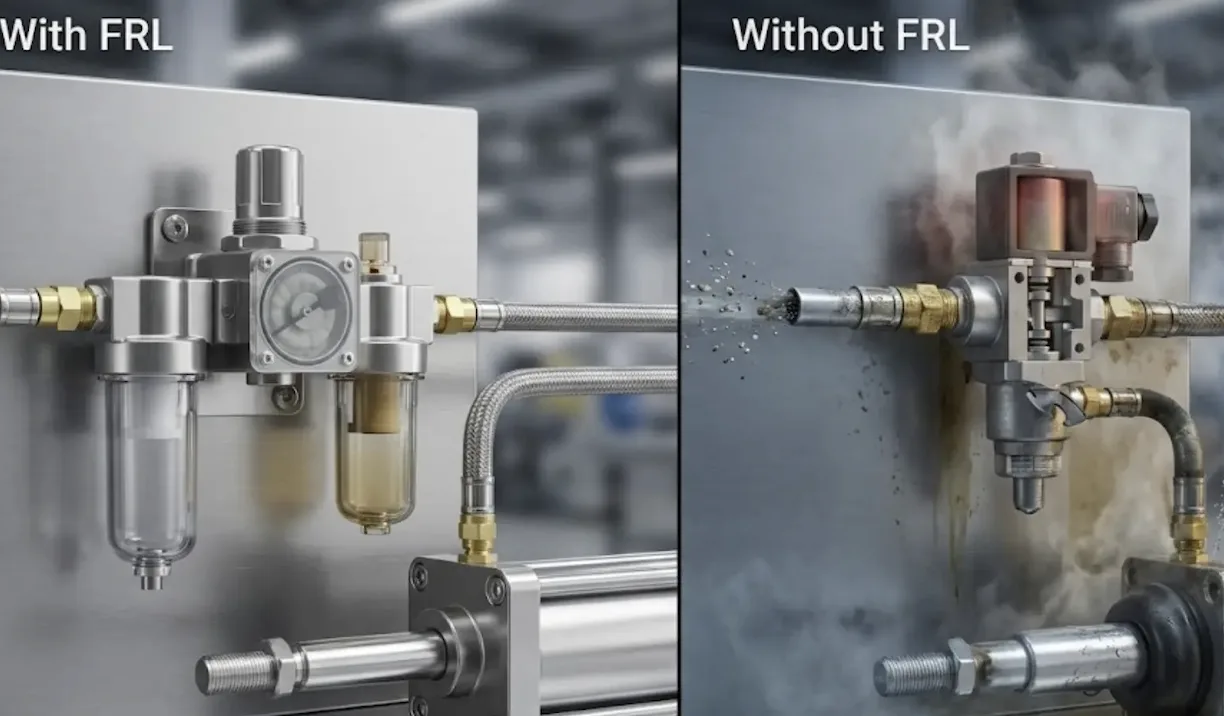
A pneumatic system is an automated technology that uses compressed air for power transmission and control. Within this system, pneumatic components (such as cylinders and solenoid valves) act as the “muscles” and “brain” of the operation. However, the raw air generated by a compressor is rarely pure; it often contains condensation, rust debris, and carbonized oil residue. If these impurities enter the system directly, they cause seal wear and valve jamming, leading to expensive production downtime. The FRL unit is designed to treat these contaminants before they can cause damage.
The Structure of FRL: A Triple-Action System
The FRL unit is a modular assembly consisting of three functional components: the Filter, the Regulator, and the Lubricator. This modular design allows air to be purified, depressurized, and lubricated in a specific sequence, ensuring that the air reaching downstream equipment meets the rigorous standards required for precision components.
In-Depth Analysis: The Working Principles of FRL Components
The Filter — Centrifugal and Interception Principle As compressed air enters the filter bowl, it first passes through deflector vanes that force the airflow into a
high-speed centrifugal “cyclone.” This centrifugal force flings heavier water droplets, oil mist, and large particles against the inner wall of the bowl, where they
collect at the bottom. Subsequently, the air passes through a porous filter element (typically with a 5μm or 40μm rating) that intercepts microscopic dust and
impurities. The treated, clean air then flows through the center to the next stage.
The Regulator — Diaphragm Balance and Feedback Principle The regulator’s role is to stabilize fluctuating inlet pressure into a constant working pressure.
When you turn the adjustment knob, you are compressing the internal main spring, which pushes down on the diaphragm and opens the valve seat. As
downstream pressure reaches the set point, air pressure travels through a feedback hole to the underside of the diaphragm, creating an upward force to counter the
spring. This diaphragm balance mechanism senses pressure fluctuations in real-time and automatically micro-adjusts the valve opening to ensure a consistent
output pressure.
The Lubricator — The Venturi Effect As the clean, regulated air flows through a restriction (venturi) inside the lubricator, the narrowed passage causes the air
velocity to increase, creating a local vacuum. Based on the Venturi Effect, this pressure differential draws lubricating oil from the reservoir into the drip tube. The oil
droplets are then shattered by the high-pressure airstream into a fine suspended oil mist (usually smaller than 2μm). This mist is carried by the airflow to the
cylinders and valves, forming a continuous protective lubrication film on all internal metal surfaces.
Why Working Principles Dictate System Lifespan
Understanding the mechanics of an FRL unit reveals why it is the key to “zero downtime.” Filtration failure leads to jammed valves, pressure fluctuations cause inconsistent machine cycles, and a lack of lubrication causes cylinder seals to fail rapidly due to dry friction. By utilizing the precision collaboration of an FRL unit, overall pneumatic system failure rates can be reduced by over 80%, making it the most cost-effective investment for any automated production line.
SENYA — A Leading Pneumatic Air Components Manufacturer
As a premier pneumatic air components manufacturer, we are dedicated to providing high-standard air preparation solutions to a global clientele. Our core
product range includes high-performance FRL Units, precision Pneumatic Cylinders, fast-response Solenoid Valves, and highly reliable Pneumatic Fittings &
Tubing. With superior manufacturing processes and rigorous quality control, we provide comprehensive OEM/ODM support to ensure your pneumatic systems
maintain peak performance under any operating conditions.You can visit our website or just contact us directly!