
Industrial flow control relies heavily on two primary actuation methods: electromagnetic and fluid power. Choosing between a solenoid valve and a pneumatic valve requires an understanding of response times, environmental constraints, and energy efficiency. While both components regulate fluid or gas flow, their internal mechanisms and power sources differ significantly, impacting long-term operational costs and system reliability in automated production lines.
Core Differences Between Solenoid and Pneumatic Actuation
A solenoid valve is an electromechanical device that uses an electric current to generate a magnetic field, which moves a plunger to open or close the valve orifice. In contrast, a pneumatic valve utilizes compressed air to move a piston or diaphragm, shifting the valve spool into the desired position. According to technical reports from the International Society of Automation (ISA), solenoid valves are preferred for high-speed, low-flow applications, while pneumatic systems excel in heavy-duty environments requiring high torque and safety in explosive atmospheres.
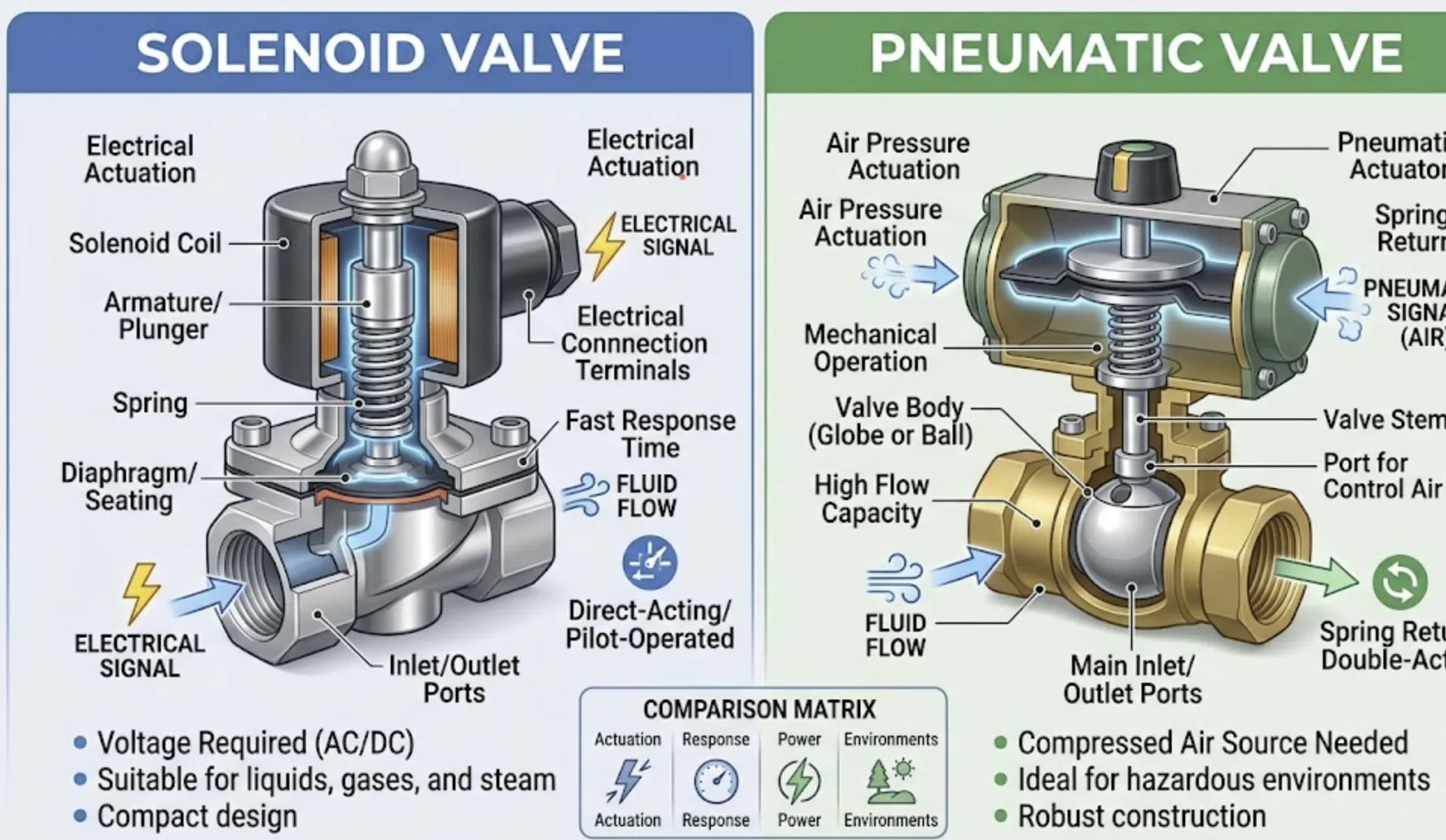
Technical Specification Comparison
The following table outlines the fundamental performance metrics for standard industrial models, facilitating an objective comparison of their functional capacities.
| Feature | Solenoid Valve | Pneumatic Valve |
| Power Source | Electricity (AC/DC) | Compressed Air (6-10 bar) |
| Response Time | 5ms to 50ms | 30ms to 150ms |
| Duty Cycle | Limited by Heat Dissipation | Continuous Operation |
| Fail-Safe Mode | Spring Return (Electric) | Mechanical Spring or Air Tank |
| Torque/Force | Moderate | Very High |
Advantages of Electric Solenoid Control Systems
Solenoid valves offer unparalleled precision for automation tasks that require rapid cycling. Since these devices integrate directly with Programmable Logic Controllers (PLCs), they eliminate the need for air compressors and complex piping in small-scale installations. Engineers often select a 2/2 way solenoid valve for liquid handling and gas shut-off applications where instantaneous response is a critical safety requirement.
Integration with digital control systems is a primary benefit of electric actuation. Modern solenoid units support various voltages and can be fitted with low-power coils to minimize energy consumption. For systems requiring diverse mounting options, using a solenoid valve manifold allows for the centralized control of multiple fluid lines, reducing the overall footprint of the control cabinet and simplifying electrical wiring.
Strengths of Pneumatic Actuated Valve Systems
Pneumatic valves are the industry standard for hazardous environments where electrical sparks pose a combustion risk. These valves utilize air pressure to provide high mechanical force, making them suitable for large-diameter pipelines and heavy viscous fluids. A standard pneumatic directional control valve remains operational even under extreme temperatures and high vibration levels that might cause electronic components in a solenoid to fail prematurely.
Durability and heat resistance define the pneumatic advantage. Unlike electromagnetic coils, which can burn out if energized for extended periods without cooling, pneumatic actuators do not generate internal heat during the holding phase. Implementing a 4V series pneumatic valve ensures consistent performance in high-duty cycle manufacturing processes, such as packaging or automotive assembly, where the valve may cycle thousands of times per hour.
Operational Constraints and Limitations
The primary disadvantage of solenoid valves is their sensitivity to power fluctuations and potential for coil burnout. Additionally, the magnetic force generated is often insufficient to operate large-scale valves against high fluid pressure without pilot assistance. Data from the U.S. Department of Energy (DOE) indicates that while individual solenoid valves consume low power, the cumulative heat in dense banks can affect surrounding sensitive electronics, necessitating cooling fans or heat sinks.
Pneumatic systems, conversely, require a continuous supply of clean, dry, and lubricated air. The infrastructure for compressed air, including compressors, dryers, and filters, involves significant upfront capital expenditure. Furthermore, pneumatic actuation is inherently less energy-efficient than direct electric control due to losses in air compression and potential leaks in the distribution network. The use of specialized pneumatic fittings and connectors is essential to mitigate these leaks and maintain system pressure.
Performance Analysis: Speed vs. Force
In terms of mechanical performance, the choice depends on whether the application prioritizes speed or raw power. Solenoid valves are the fastest, often reaching full transition in under 10 milliseconds. This makes them ideal for sorting machines and inkjet printing. However, if the task involves moving a heavy gate or ball valve, a pneumatic actuator is necessary to overcome the static friction and fluid resistance found in industrial processing.
| Application Criteria | Recommended Technology | Reasoning |
| Explosive Atmosphere | Pneumatic | No electrical spark risk (ATEX compliant) |
| Compact Lab Equipment | Solenoid | Small footprint, no compressor needed |
| High Frequency Cycling | Solenoid | Faster response and lower latency |
| Large Scale Infrastructure | Pneumatic | Higher force-to-weight ratio |
Environmental Impact and Safety Standards
Safety standards such as IEC 61508 for functional safety play a vital role in valve selection. In many chemical plants, pneumatic valves are chosen because they can be easily configured for “fail-safe” positions using mechanical springs that do not rely on stored electrical energy. For simpler air control tasks, a pneumatic mechanical valve provides a reliable, manual, or cam-operated alternative that functions without any external power source.
According to a 2025 Industrial Automation Report, the transition toward “Green Manufacturing” is driving the development of more efficient solenoid coils. Modern designs have reduced holding current by up to 70% compared to models from a decade ago. Nevertheless, for heavy industry, the reliability of a robust pneumatic air cylinder coupled with a pneumatic control valve remains the preferred solution for long-term mechanical stability in harsh outdoor or wash-down environments.
Maintenance and Long-Term Reliability
Maintenance requirements for solenoid valves focus on the electrical integrity of the coil and the cleanliness of the fluid. Particulate matter can easily clog the small pilot orifices of a solenoid, leading to failure. Pneumatic valves are more tolerant of contaminants but require regular inspection of seals and O-rings to prevent air leakage. Proper installation of pneumatic mufflers and silencers is also required to manage the noise pollution generated by exhausting air.
Conclusion: Selecting the Right Valve Technology
The decision between solenoid and pneumatic valves is governed by the specific requirements of the automation system. Solenoid valves offer the best solution for rapid, precise, and electrically integrated flow control in clean environments. Pneumatic valves remain the superior choice for high-force applications, hazardous locations, and systems where compressed air infrastructure is already established. Balancing the initial investment against operational efficiency and maintenance needs is the key to optimizing industrial fluid power systems.
FAQ
Can a solenoid valve be used in a pneumatic system?
Yes, a solenoid-controlled pneumatic valve uses an electric signal to manage the flow of compressed air, which then actuates a larger valve spool. This hybrid approach combines the fast signal processing of electronics with the high mechanical force of pneumatic power for complex industrial automation.
How do I troubleshoot a solenoid valve that won’t open?
First, verify the input voltage matches the coil specifications using a multimeter. If the electrical supply is stable, check for a burnt-out coil or a clogged pilot orifice. Mechanical obstruction within the valve body caused by fluid debris is another common cause of failure in electromagnetic actuators.
What are the safety benefits of pneumatic valves in oil and gas?
Pneumatic valves are inherently explosion-proof because they operate using air pressure rather than electricity. In environments with flammable vapors, removing electrical components eliminates the risk of ignition. Furthermore, pneumatic actuators can provide high-speed emergency shutdown (ESD) capabilities using stored compressed air tanks.
Which valve type has a longer service life?
Pneumatic valves generally have a longer mechanical service life in heavy-duty applications because they lack delicate electronic components. However, solenoid valves can achieve millions of cycles in light-duty, clean environments if the electrical coil is protected from overheating and voltage spikes through proper circuit design.
How does fluid temperature affect valve selection?
High fluid temperatures can degrade the insulation of a solenoid coil, leading to premature failure. In such cases, pneumatic valves or solenoids with high-temperature FKM or PTFE seals are required. For extreme heat, pneumatic actuators are preferred as the power source is physically isolated from the heated valve body.