
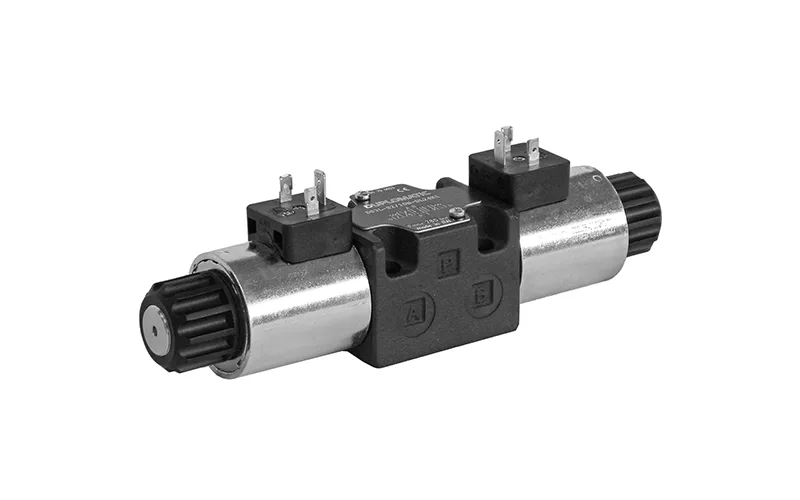
In hydraulic or pneumatic systems, directional control valves (DCVs) are far more than simple switches; they are the commanders of the entire circuit. Often called “discrete valves,” they determine every action logic of the system by precisely controlling the flow path of the fluid.
Furthermore, using directional control valves offers the following advantages:
Isolating a branch in the circuit
Bypass valves or return line filters
Preventing unidirectional flow
Protecting hydraulic components from pressure surges
Directional control valves primarily guide the system medium and are the command structure component of the actuator.
There are four main actuation methods:
Manual Directional Valve:
The spool is manually moved by operating a handle, pressing a button, or stepping on a foot pedal.
Mechanical Directional Valve:
The spool moves via mechanical linkages such as cams and rollers.
Solenoid-driven Directional Valve:
Energizing the solenoid coil or solenoid valve generates magnetic force, pulling the armature into the coil, thereby actuating the valve spool. It’s important to note that when the fluid flow rate exceeds 25 gpm, the solenoid valve itself may be insufficient to drive the direct-flow valve spool, and it may also fail to generate sufficient thrust without adequate power. Nevertheless, solenoid valves remain widely used.
Pilot-operated Directional Valve:
When the fluid pressure in the hydraulic system moves the valve spool to a predetermined position, pilot pressure is activated. Pilot pressure is introduced by applying a pilot signal (suitable for hydraulic or pneumatic systems) to the pistons at both ends of the valve spool, thereby causing the pistons to move the valve spool.
Pneumatic Control:
Utilizing air pressure as a signal, suitable for flammable, explosive, or strongly electromagnetically interfered environments.
Furthermore, valves are categorized by the number of channels and positions (2-way, 3-way, or 5-way), valve spool structure (spool type vs. shut-off type), and by their operating mode (single-acting vs. double-acting).
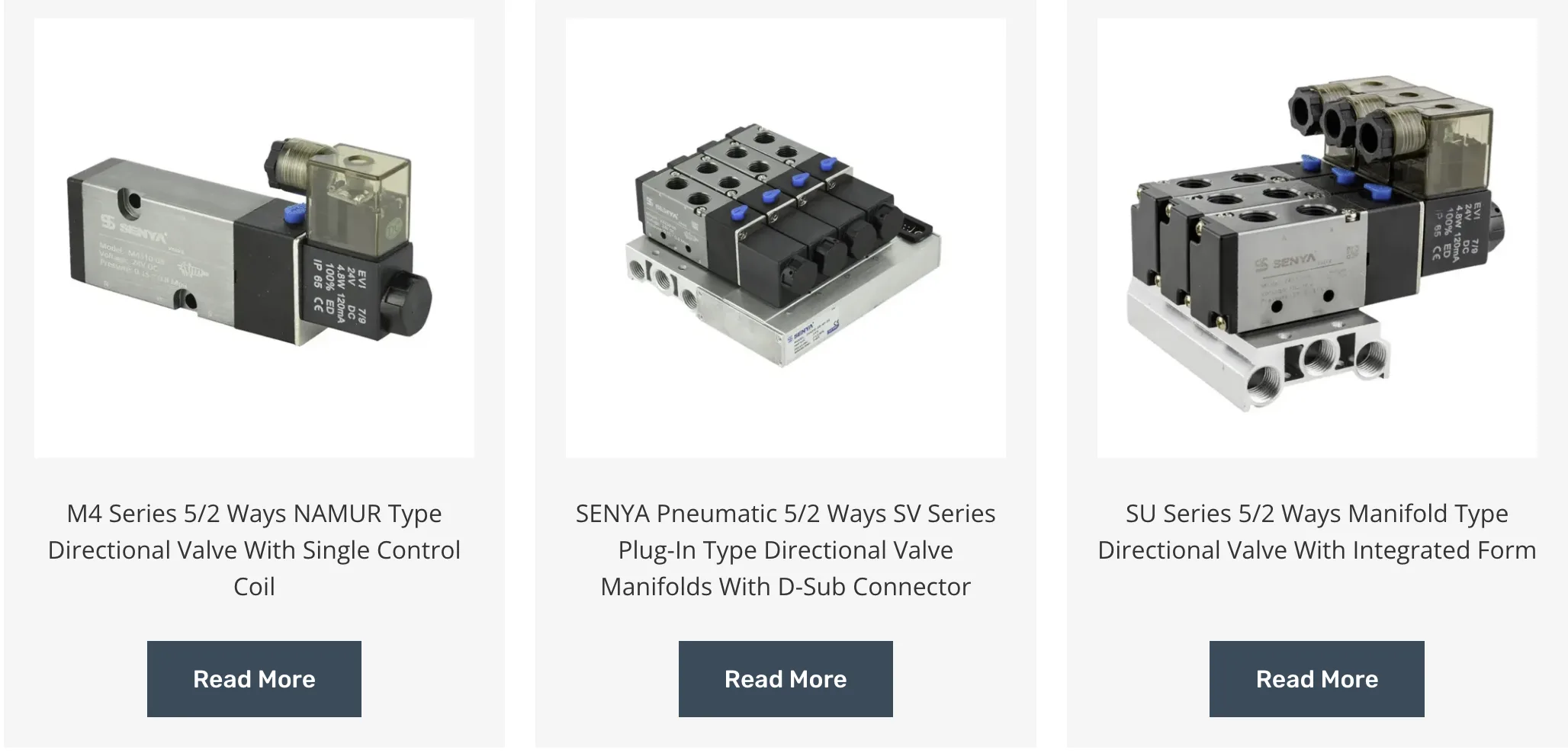
SENYA Pneumatic Directional Valve Types
FAQ
Q1: Why are directional control valves considered the “brain” of a system?
A: They direct the path of fluid (air or oil). By switching internal passages, they command actuators to start, stop, or change direction, forming the core logic of automation.
Q2: What does “Ways” and “Positions” mean (e.g., 5/2-way)?
A: “Positions” refers to the number of functional states (e.g., 2 positions for “on” and “off”). “Ways” refers to the number of ports on the valve. A 5/2-way valve has 5 ports and 2 switching states, typically used for double-acting cylinders.
Q3: What are the advantages of a Spool Design?
A: The spool shifts laterally to switch flow paths. This design is balanced, requiring minimal force to operate, and allows for complex configurations (like 3-position valves) within a single compact body.
Q4: How do these valves protect the system?
A: Beyond switching direction, they can isolate specific circuit branches for maintenance, bypass fluid to filters, and act as a barrier to protect sensitive components from sudden pressure shocks.