
In modern industrial automation, compressed air is often referred to as the “fourth utility.” However, since the air discharged from an air compressor typically
contains moisture, dust, and oil residue, using it directly can significantly shorten the lifespan of pneumatic components. This is where the FRL Unit (Air
Preparation Trio) comes into play—it serves as the essential “guardian” of any pneumatic system.
Definition of Pneumatic Systems
A pneumatic system is an automation technology that utilizes compressed air as a medium for power transmission. Within the system, pneumatic components such
as cylinders and solenoid valves act as actuators, driving robotic arms, packaging lines, and assembly machines. However, the performance of these precision
components is highly dependent on the “cleanliness” of the power source. Untreated compressed air leads to seal corrosion and valve jamming; therefore, air
preparation is the cornerstone of ensuring efficient system operation.
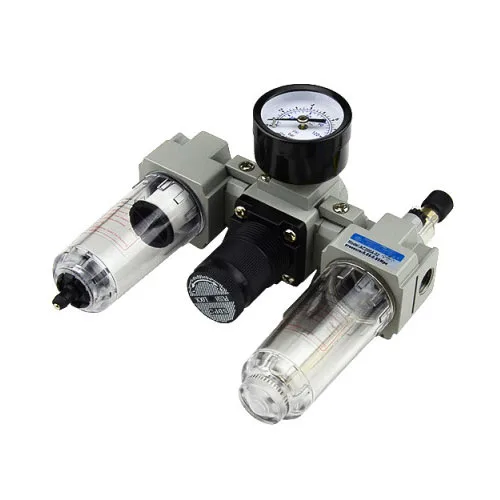
Anatomy of the FRL Unit
An FRL unit consists of three collaborative functional components, each designed to address specific issues within the compressed air.
Filter: This is the system’s first line of defense. It uses centrifugal force to fling out large moisture droplets and employs a filter element to intercept solid impurities in the air.
Regulator: Acting as the system’s stabilizer, it uses an adjustable spring and diaphragm structure to convert fluctuating inlet pressure into a stable output pressure, ensuring downstream equipment operates under constant thrust.
Lubricator: The system’s “refueling station,” which uses the Venturi effect to atomize lubricating oil into the airstream, providing essential lubrication for the moving parts inside cylinders and valve bodies.
How Does The FRL Unit Work?
In a standard cycle, compressed air first enters the Filter for dehydration and dust removal. It then proceeds to the Regulator, where a pressure-balancing
mechanism locks the air pressure at a preset value (e.g., 6 bar). Finally, the dry air flows through the Lubricator, carrying a fine oil mist to the downstream
components. This linear logic of “filtration-regulation-lubrication” ensures that every cubic centimeter of air provides the optimal power environment for downstream elements.
Why FRL is Critical
Installing an FRL unit is not just a technical requirement; it is a strategic economic choice
Extended Component Lifespan: Effectively prevents moisture from causing internal rust in pneumatic piping and cylinders.
Improved Production Precision: Stable pressure output ensures consistent cylinder thrust, avoiding defect rates caused by pressure fluctuations.
Reduced Maintenance Costs: Proper lubrication significantly reduces wear on solenoid valve seals, markedly lowering high costs associated with downtime and maintenance.
Pneumatic Components Manufacturer
As an elite pneumatic air components manufacturer, we SENYA Pneumatic specialize in air preparation technologies and are dedicated to providing high-performance solutions for global industrial automation. Our product portfolio encompasses core Air Preparation Units (FRL Units), high-precision Pneumatic Cylinders, fast-response Solenoid Valves, and highly reliable Pneumatic Fittings & Tubing. With leading manufacturing processes and rigorous quality inspection standards, we provide not only standard parts but also comprehensive OEM/ODM customization, you can visit our blog page according to different pneumatic components and empower your equipment to be more competitive in the global market.