

Selecting the right solenoid valve is crucial for the efficiency and reliability of fluid control systems. Approximately 30% of failures in solenoid valves occur due to improper sizing or solenoid valve selection. This statistic underscores the importance of making informed choices. A well-chosen 2/2 ways solenoid valve guide enhances system performance by ensuring precise control and minimizing energy consumption. Key factors to consider include fluid characteristics, flow requirements, and selecting valve body material. Additionally, understanding the differences between brass vs stainless steel valves and ensuring chemical compatibility for valves can significantly improve operational efficiency and reduce long-term costs.
Key Takeaways
- Understand your fluid characteristics. Different fluids require different valve sizes and materials for optimal performance.
- Evaluate flow requirements carefully. Ensure the valve can handle the maximum flow rate without causing pressure drops.
- Select the right materials. Match valve materials to the fluid type to prevent corrosion and ensure longevity.
- Consider electrical needs. Choose the correct voltage and power specifications to enhance efficiency and reliability.
- Assess environmental conditions. Ensure the valve can withstand temperature, humidity, and dust to maintain performance.
Define Your Application Needs

Choosing the right 2-way solenoid valve begins with a clear understanding of your application needs. This involves evaluating several critical factors that influence valve performance and compatibility.
Identify Fluid Characteristics
Fluid characteristics play a vital role in solenoid valve selection. Different fluids exhibit unique properties that can affect valve operation. Common types of fluids managed by 2-way solenoid valves in industrial applications include:
- Water
- Air
- Oil
- Gases
Understanding the viscosity and particulate content of the fluid is essential. High viscosity liquids require larger orifices and more powerful actuators to manage slower flow rates. Conversely, gases, which have lower viscosity, allow for smaller orifices and less powerful actuators, leading to more compact designs.
Additionally, particulate filtration is crucial to prevent shifting failures in air-actuated solenoid valves. Moisture control is necessary to avoid emulsification of lubrication, which can lead to sticky residues. Fragments from PTFE tape or pipe scale can obstruct pilot orifices, causing operational issues.
Determine Flow Requirements
Flow requirements dictate the size and type of solenoid valve needed for your system. Several factors influence flow rates, including:
- Valve inlet pressure
- Valve outlet pressure
- Fluid density
- Maximum flow rate required
- Fluid temperature
The application’s Kv value must be lower than the valve’s Kvs value at maximum opening. This ensures that the valve can handle the required flow without causing excessive pressure drops. Properly assessing these parameters helps prevent operational inefficiencies and potential system failures.
Assess Pressure and Temperature Conditions
Pressure and temperature conditions significantly impact the operational reliability of solenoid valves. Fluctuations in these parameters can lead to various issues. The following table summarizes the effects of pressure and temperature on valve performance:
| Evidence Description | Impact on Operational Reliability |
|---|---|
| High duty cycles lead to increased power usage and temperature rise. | Can cause overheating and potential failure. |
| Prolonged operation at high temperatures results in thermal expansion and deformations. | Affects valve performance and reliability. |
| Wear and friction of components degrade performance and can lead to failure. | Increases risk of operational issues. |
| Elevated temperatures and wear can cause seals to leak. | Compromises sealing capabilities, affecting reliability. |
Maintaining stable pressure dynamics is crucial, especially in high-risk systems. It ensures consistent valve performance under varying conditions and prevents catastrophic failures.
Evaluate Performance Parameters of Solenoid Valves

Selecting the right solenoid valve requires careful evaluation of performance parameters. These parameters directly influence the efficiency and reliability of fluid control systems.
Understand Valve Sizing
Valve sizing is critical for optimal performance. Incorrect sizing can lead to significant operational issues. To calculate the correct valve size for a given flow rate and pressure, consider the following equations:
| Media Type | Equation | Considerations |
|---|---|---|
| Liquid | Cv = q ( g / ΔP )1/2 | Avoid cavitation by ensuring ΔP does not exceed 50% of upstream pressure. |
| Gas | Cv = ( Q / 963 ) ( ( G × T ) / ( ΔP × ( P1 + P2 ) ) )1/2 | Critical flow occurs when ΔP exceeds 50% of upstream pressure. |
| Steam | Cv = W / ( 2.1 [ ΔP × ( P1 + P2 ) ]1/2 ) | Consider enthalpy and temperature effects. |
Failure to size valves correctly can result in various issues:
- Undersized Orifice (Too Small): Causes high pressure drops and inefficiencies, leading to increased energy costs and potential safety hazards due to insufficient relief.
- Oversized Orifice (Too Large): Results in poor control and system instability, which can lead to erratic flow adjustments and increased wear on components.
- Increased Wear & Tear: Both types of incorrect sizing contribute to valve damage, leading to leaks and higher maintenance costs.
- System Instability & Inefficiency: Disrupts flow dynamics, causing energy waste and unsafe conditions in critical applications.
Review Response Time and Cycle Rate
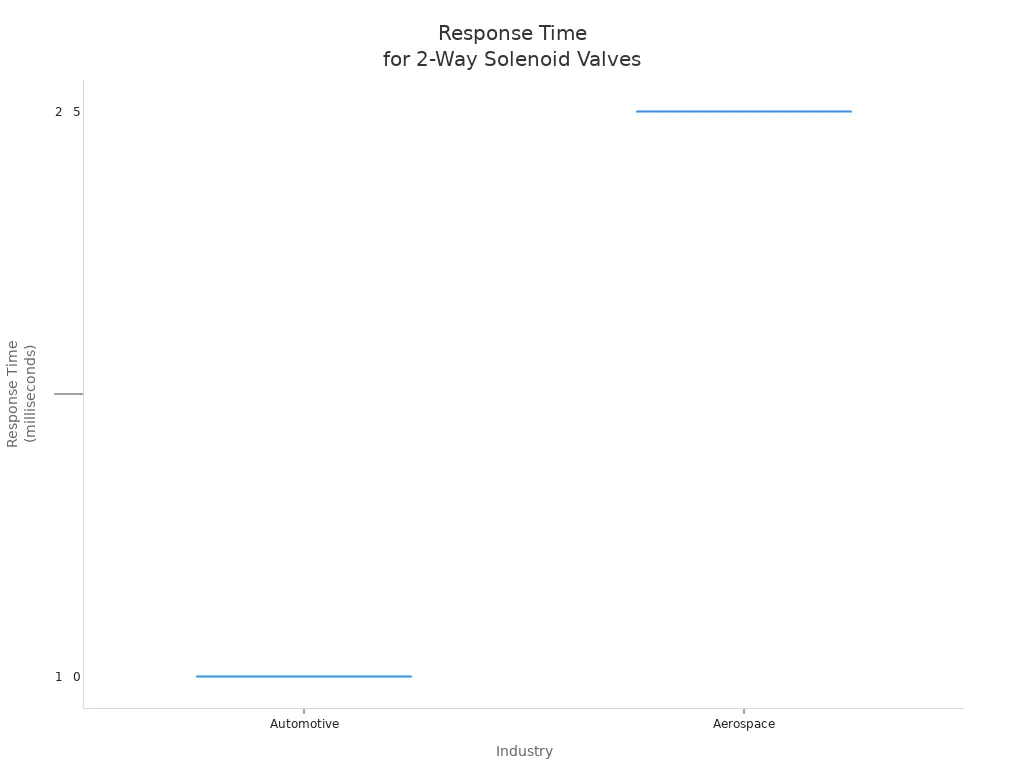
Response time and cycle rate are essential for the effective operation of solenoid valves. The typical response time for 2-way solenoid valves varies by industry:
| Industry | Typical Response Time Range |
|---|---|
| Automotive | 1-2 milliseconds |
| Aerospace | Under 5 milliseconds |
| Process Industries | 10-15 milliseconds or less |
| Robotics and Automation | As low as 0.5 milliseconds |
| Medical Devices | 3-5 milliseconds |
Higher cycle rates can lead to increased wear and tear on solenoid valves. Frequent energization increases mechanical wear on the plunger and related components, leading to degradation in performance. Additionally, higher duty cycles can cause insulation breakdown and reduced performance due to increased heating.
Consider Leakage Rates
Leakage rates significantly impact the efficiency and safety of fluid control systems. Acceptable leakage rates for 2-way solenoid valves are defined by industry standards:
| Leakage Class | Acceptable Leakage Rate (ml/min) | Conditions |
|---|---|---|
| Class VI | 0.15 to 0.3 | Air or nitrogen at 50-125°F (10-52°C) |
Maintaining leakage rates within limits is essential for several reasons:
- Safety: Prevents hazardous fluid escape, ensuring personnel and environmental safety.
- Regulatory Compliance: Adhering to allowable leakage rates is necessary to meet strict industry regulations on fluid containment and environmental protection.
- Equipment Protection: Helps prevent damage to pumps and surrounding equipment, ensuring machinery integrity and longevity.
- Operational Efficiency: High leakage rates can result in fluid loss and decreased system efficiency, while keeping leakage within limits promotes optimal performance.
- Maintenance and Downtime: Effective leakage management reduces the frequency of maintenance and unscheduled downtime, leading to more reliable operations.
By carefully evaluating these performance parameters, engineers can select solenoid valves that enhance system reliability and efficiency.
Consider Material Compatibility for Solenoid Valves
Selecting the right materials for solenoid valves is essential for ensuring optimal performance and longevity. Material compatibility directly affects the valve’s ability to handle specific fluids and environmental conditions.
Match Valve Materials to Fluid Type
Different materials suit various fluid types. The following table outlines common materials used in 2-way solenoid valves and their compatibility:
| Material | Best For | Why Use It |
|---|---|---|
| Brass | Water, air, light oil, non-corrosive fluids | Durable, handles heat well, cost-effective |
| Stainless Steel | Corrosive chemicals, food processing | Superior resistance to corrosion and high temperatures |
| Plastic | Strong acids, alkalis | Rust-proof, cost-effective, but lower ratings |
- Brass Valves: Suitable for non-aggressive fluid service, ideal for low to medium-pressure applications.
- Stainless Steel Valves: Preferred for harsh, aggressive fluid flow applications, offering high mechanical strength and corrosion resistance.
- Plastic Valves: Best for cost-sensitive applications like water purifiers, handling strong acids and alkalis.
Evaluate Corrosion Resistance
Corrosion resistance is crucial when selecting materials for solenoid valves. Long-term exposure to corrosive fluids can lead to material degradation. This degradation increases maintenance needs and shortens the valve’s lifespan. For instance, stainless steel, particularly grades 316 and 316L, is highly recommended for applications involving seawater or strong acids due to its low corrosion rates.
Assess Temperature and Pressure Ratings
Temperature and pressure ratings significantly influence material selection. Solenoid valves come in various housing materials, including Nylon, PVC, Brass, and Stainless Steel. The choice of material must align with the chemical properties and temperature of the medium. Adhering to maximum permitted fluid and ambient temperatures is vital to avoid thermal damage. The highest allowable temperature typically depends on the thermal durability of the sealing materials used in the valve.
By carefully considering material compatibility, engineers can enhance the reliability and efficiency of their fluid control systems.
Address Electrical Requirements for Solenoid Valves
Electrical requirements play a crucial role in the performance of solenoid valves. Properly addressing these needs ensures reliable operation and efficiency in fluid control systems.
Determine Voltage and Power Needs
Voltage and power specifications are vital for solenoid valve selection. Different applications require various voltage types and power ranges. The following table summarizes common voltage types and their corresponding power ranges:
| Voltage Type | Power Range |
|---|---|
| 24V DC | 10W – 19W |
| 110V AC | 10.5 VA – 21VA |
| 230V AC | 9VA – 15VA |
Selecting the appropriate voltage and power rating directly impacts operational costs. Factors such as the size of the solenoid valve, peak current requirements, operating voltage, and duty cycle all influence power consumption. For instance, larger valves typically draw more energy due to higher current demands. Additionally, a brief surge in current is necessary to operate the valve, affecting overall energy use.
Evaluate Control Options
Control options for solenoid valves vary widely. Engineers can choose between direct control, pulse-width modulation, or proportional control methods. Each option offers distinct advantages based on the application. Direct control provides straightforward operation, while pulse-width modulation allows for energy savings by reducing power during non-active periods. Proportional control offers precise flow regulation, enhancing system efficiency.
Consider Environmental Conditions
Environmental factors significantly affect solenoid valve performance. Extreme temperatures can cause material contraction or expansion, leading to potential failures. High humidity may result in corrosion and electrical shorts due to moisture ingress. Dusty environments can lead to clogging and wear, degrading valve performance over time.
In applications such as military vehicles, solenoids must withstand harsh conditions, including dirt, humidity, and temperature extremes. Selecting solenoid valves with appropriate ingress protection (IP) ratings is essential. Common ratings include IP65, IP67, and IP68, which indicate varying levels of protection against solid and liquid ingress. Choosing the right IP rating ensures solenoid valves can operate effectively in challenging environments.
Selecting the right 2-way solenoid valve is essential for optimizing fluid control systems. Key criteria include:
- Valve actuation
- Valve types and configurations
- Number of ports and position
- Principle of operation
- Circuit function
- Pipe diameter and thread type
- Orifice, Kv-value, and flow rate
- Medium compatibility
- Pressure and temperature ratings
- Response time
- Voltage requirements
- IP-rating
Engineers should assess specific application needs to ensure compatibility and reliability. Proper valve selection leads to enhanced energy efficiency, improved system reliability, and reduced operational costs. Ultimately, investing time in the selection process pays off in long-term performance and sustainability.
FAQ
What is a 2-way solenoid valve?
A 2-way solenoid valve controls fluid flow in a system. It has two ports: one for inlet and one for outlet. When energized, the solenoid actuates the valve, allowing or blocking fluid passage.
How do I know the right size for my solenoid valve?
To determine the correct size, calculate the required flow rate and pressure drop. Use the valve sizing equations for liquids or gases. Ensure the valve’s Kv value exceeds the application’s Kv requirement.
What materials are best for corrosive fluids?
Stainless steel is ideal for corrosive fluids due to its high resistance to corrosion. For strong acids or alkalis, plastic valves may also be suitable. Always match materials to the specific fluid type.
How do environmental conditions affect solenoid valve performance?
Extreme temperatures, humidity, and dust can impact solenoid valve operation. High humidity may cause corrosion, while dust can lead to clogging. Select valves with appropriate ingress protection ratings for harsh environments.
What are the common voltage options for solenoid valves?
Common voltage options include 24V DC, 110V AC, and 230V AC. Each voltage type has specific power requirements. Choose the voltage that aligns with your system’s electrical specifications for optimal performance.